Ghost Lines and Green Tunnels: Following Scotland's Forgotten Railways on Foot

Photo by Photo by Connor Mollison on Unsplash on Unsplash
There's a particular kind of silence you only get on a disused railway. Not the silence of empty moorland, which hums with wind and skylarks, but a constructed silence — the quiet of a place built for noise, whistles, shunting and steam, now given over to nothing but your own footsteps.
The Highlands are stitched together with these ghost lines. The great railway mania of the Victorian era pushed iron as far into the glens as money and dynamite allowed, and when the trains stopped — mostly in the 1960s, courtesy of the Beeching axe — the routes didn't vanish. They just lay down and let the greenery take over. Today, they've been reborn as some of the finest walking and cycling paths in Scotland: gentle gradients (trains, famously, don't do steep), stone viaducts still standing proud, and the occasional platform peeking out of the undergrowth like a forgotten gravestone.
Picking Your Line
You're spoiled for choice. The Speyside route from Ballindalloch to Craigellachie is probably the most polished, all whin-bushed cuttings and views down to the river. Down south, the old Ballachulish branch out of Connel is shorter but arguably more atmospheric — you walk the same path the ballast trains once took toward the slate quarries at the head of Loch Creran, and parts of it feel like the railway simply paused for a tea break in 1966 and never came back.
For this piece, though, let's follow the Speyside line properly, end to end, because it's the one that best rewards a full day.
Ballindalloch to Craigellachie: The Route
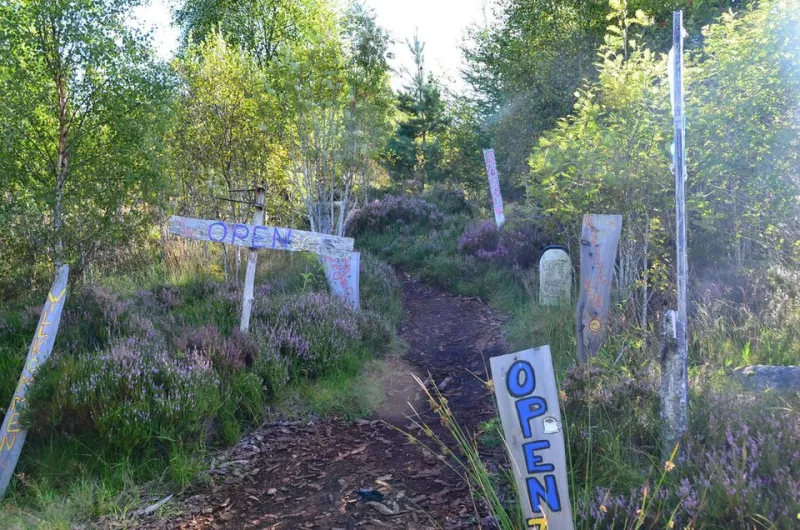
Start at Ballindalloch, ideally with a detour to the castle grounds or — more importantly — a dram's worth of self-restraint saved for later, because you're walking into whisky country. The path follows the old trackbed northeast through mixed woodland, and within ten minutes you'll understand the appeal: the cuttings have grown into green tunnels, birch and rowan closing overhead, the old embankments soft and mossy underfoot.
The gradient is so gentle you'll forget you're climbing at all — the great gift of railway walking. Expect around eleven miles door to door, mostly level, mostly well-surfaced, and suitable for bikes as well as boots.
The highlights come in waves. There's the magnificent viaduct at Carron, all seven arches of red sandstone straddling the river gorge, where it's practically compulsory to stop and gawp. Then the line swings past the distilleries at Dailuaine and Benrinnes — you won't see much of them through the trees, but on the right morning the air does something rather telling.
The Station That Time Forgot
Approaching Craigellachie, keep an eye out for the old platform edges — long grass now, but the stone kerbs are unmistakable. And at the end of it all sits Craigellachie itself, home to one of the most photogenic railway bridges in Britain: Thomas Bouch's cast-iron span over the Spey, built in 1863 and still carrying the road, still creaking faintly under passing cars.
This is where you celebrate. The Speyside distilleries cluster thick here — Craigellachie, Aberlour, Macallan within stumbling distance — and the Quaich Bar at the Craigellachie Hotel claims one of the largest whisky selections in Scotland. You've earned it. You did, after all, walk here at roughly the speed your great-grandparents' mail train would have done it in eight minutes.
Practicalities
- Getting there: Buses run to Ballindalloch from Aberlour and Craigellachie; some walkers cheat brilliantly by parking at Craigellachie and taking the bus to the start, walking back to the car.
- Underfoot: Mostly compacted gravel and tarmac. Fine in trainers in dry weather, but decent boots after rain — the cuttings hold water.
- Timing: Four to five hours walking at a relaxed pace, longer if you do it properly with distillery stops. Allow a full day.
- Best season: Late spring for the wild garlic, or late October when the birch turns gold and the whole green tunnel catches fire.
Why Walk a Line That's Gone?
Because railways were never just about trains — they were about the shape of the land. The engineers chose the gentlest routes, crossed rivers at the best points, and threaded through the most interesting country. Walk a disused line and you're walking the most sensible path through a glen, chosen by Victorian surveyors and now gifted to you, free, with sixty years of wilderness grown over the top.
There's something else too. Every so often you'll spot a milestone, a bridge plate, a rusted fence post, and you'll feel that small thrill of connection — the sense that you're sharing a route with a century of porters, fishermen and holidaymakers who came before. The trains are long gone. The journey, somehow, isn't.
Lace up. The last ten yards of track are waiting.